
Claude Opus 4 + RAG: Build an AI App with Embeddings & Knowledge Graphs | MVP Unplugged
Welcome to the next MVP Unplugged, where Microsoft MVPs share real-world projects and insights from the field! In this episode, host Justin Garrett sits down with Microsoft MVP Michael Washington to explore how he built AI Story Builders—an open-source (MIT) app that uses structured story data, embeddings, and Retrieval Augmented Generation (RAG) to help authors write coherent, consistent fiction.
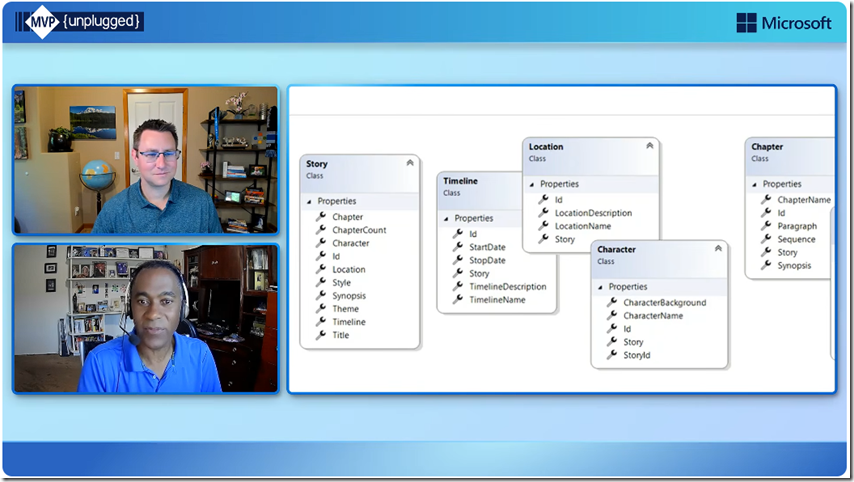
Michael walks through his full approach—from breaking a story into timeline, location, and character data, to using cosine similarity over text-file embeddings, to a new knowledge-graph layer that lets frontier models interrogate a story with tool calls. Whether you're building agents, RAG apps, or AI writing tools, this episode shows a practical, repeatable pattern you can adapt today.
What You'll Learn
✅ How to design an AI app that writes consistent stories using structure ✅ Why AI struggles to "just write the next chapter"—and how to fix it ✅ Breaking a story into timeline, location, and character data ✅ Using embeddings and cosine similarity to improve context retrieval ✅ How RAG powers real-world AI apps beyond simple prompts ✅ Why knowledge graphs unlock deeper reasoning than traditional RAG ✅ Chapter Markers
- 00:00 – Intro to MVP Unplugged
- 00:40 – Building AI Story Builders & Becoming a Microsoft MVP
- 03:31 – AI Story Builders Demo & Install (Microsoft Store)
- 04:41 – Setup: Choosing Claude Opus 4 & Creating a Story
- 06:18 – Why AI Can't Just "Write the Next Chapter"
- 08:52 – Structuring a Story: Timeline, Location, Characters
- 11:37 – Text-File Embeddings & Cosine Similarity
- 15:49 – Importing & Exporting Stories (PDF, Word)
- 17:42 – How It's Built: RAG (Retrieval Augmented Generation)
- 19:13 – Knowledge Graphs for AI Storytelling